Application
Packaging Vision Inspection
Packaging lines fail inspection projects on imaging, not algorithms. Reflective film, moving product, condensation and changeover variety decide the design.
Direct answer
How does a packaging inspection vision system work?
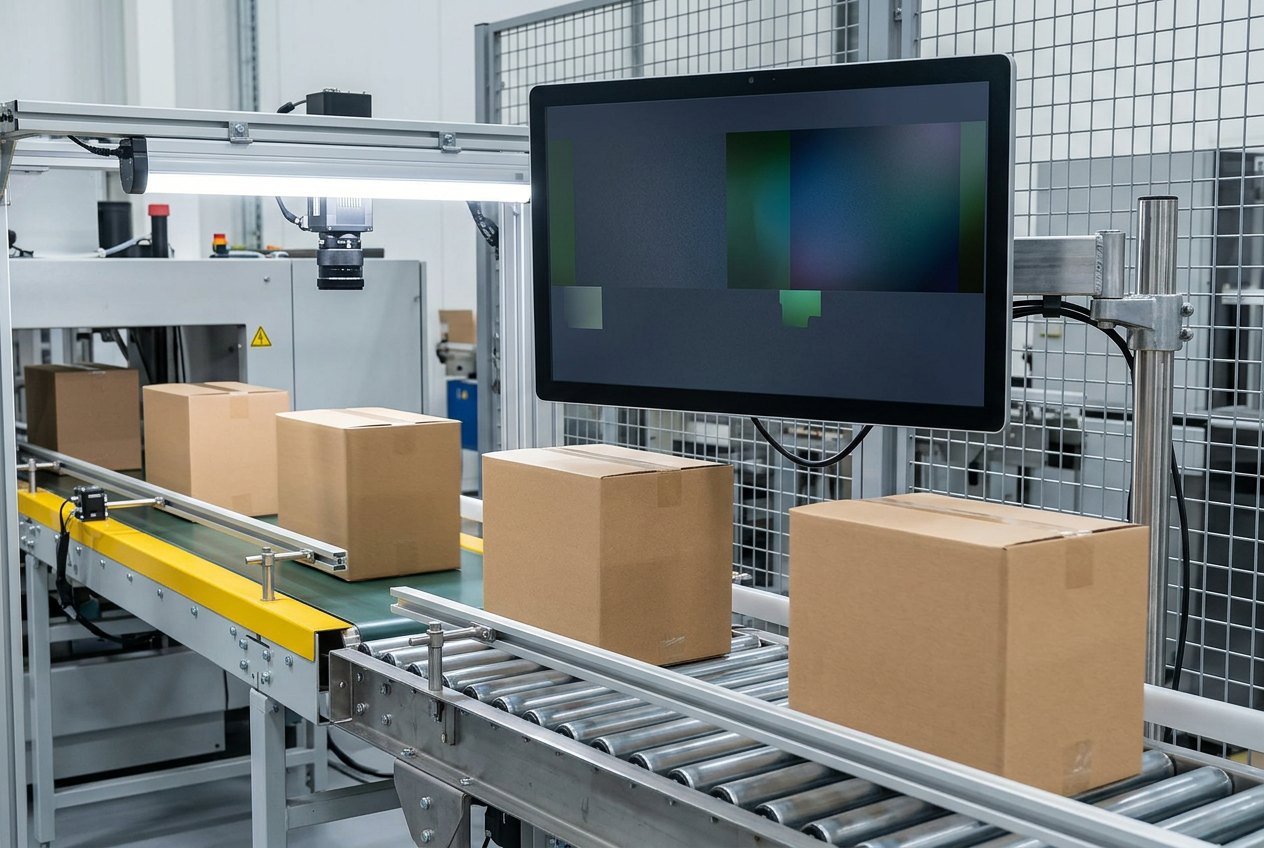
A packaging inspection system triggers a camera as each package passes a fixed station, freezes motion with a short strobed exposure, and evaluates the image for label presence and placement, print legibility, date/lot code correctness, seal region defects and closure integrity. The result is returned to the PLC within the reject window, and images plus verdicts are retained for traceability.
The imaging problem on a packaging line
Packaging surfaces are rarely cooperative. Metallized film and glossy laminates return specular hot spots that erase inkjet characters; shrink wrap distorts geometry; cold-fill products fog the outer surface; and the same station may see six SKUs in a shift.
The practical countermeasures are optical before they are computational: control the angle of incidence, choose diffuse or low-angle geometry deliberately, and constrain the presentation so the region of interest lands in the same place on every frame.
- Specular film — diffuse dome or coaxial light, cross-polarization, or a deliberately off-axis geometry so the mirror lobe misses the lens.
- Condensation and humidity — sealed IP-rated enclosures, air knife or purge at the window, and imaging placed after a dwell where practical.
- Motion blur — strobed illumination and exposure short enough that travel during exposure stays well under the smallest feature.
- SKU variety — recipe-driven inspection with per-SKU regions, tolerances and expected code strings.
What is typically inspected
- Label presence, placement, skew and wrinkle on cartons, pouches, bottles and cans.
- Date, lot and expiry code presence and correctness (OCV against the expected string, not just print presence).
- 1D/2D code read and print-quality grading for retail and pharma requirements.
- Seal and closure region: contamination in the seal band, cap position, tamper band, fill level where visible.
- Carton and case integrity: crush, open flap, missing insert, count verification.
Reference architecture
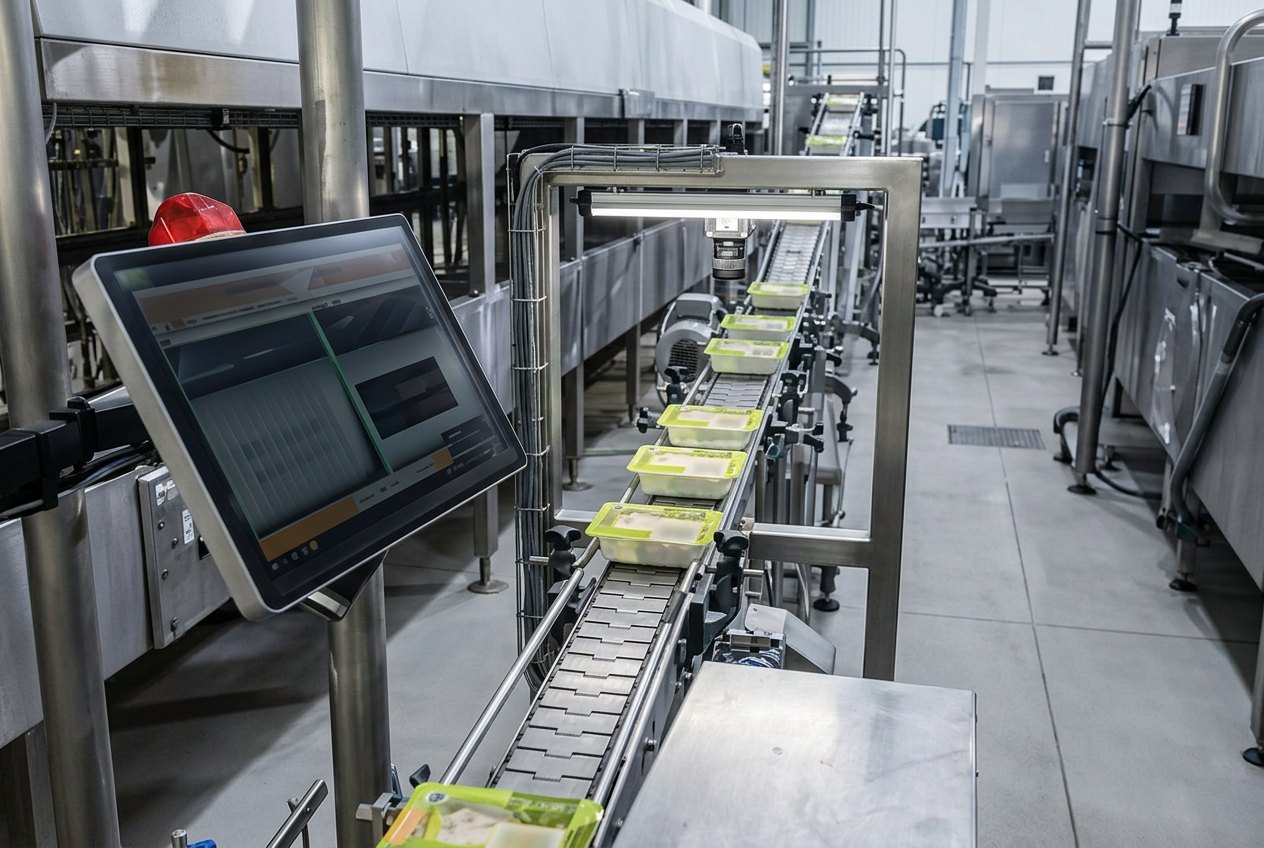
Packaging station — single-lane inspection
Validation before you trust it
A packaging inspection is accepted only against a defect panel: known-good and known-bad samples, run at line speed, with escape and false-reject counts recorded. We publish the method, and only publish numbers once a customer approves the run.
- Assemble a labeled sample set covering each defect class and each SKU.
- Run at production speed, not hand-fed, and record every verdict.
- Report escapes and false rejects separately; they have different costs and different fixes.
- Re-run after any lighting, optics or recipe change.
Frequently asked questions
- Can a vision system read date codes on reflective film?
- Usually yes, but it is an optics problem first. Cross-polarization, diffuse dome lighting, or an off-axis geometry that moves the specular lobe out of the lens are the standard approaches. Character contrast should be verified on real production samples before committing to a design.
- Do I need AI for packaging inspection?
- Often not. Code verification, label presence and placement, and dimensional checks are typically solved with rules-based tooling that is deterministic and easier to validate. Learned models earn their place for variable cosmetic defects that cannot be described by a threshold.
- How is inspection tied to the reject?
- The verdict is returned to the PLC inside the available reject window, with a defined handshake and a fail-safe default. If the vision system cannot answer in time, the line's behavior on timeout is specified explicitly rather than left to chance.
Related engineering material