Application engineering

Inspection examples

Representative inspection problems, with the imaging reasoning we apply to them: what has to be inspected, what makes it hard to image, the architecture that usually fits, and how the result is validated before handover.

Food & beverage packaging

Date and lot code verification on reflective pouches
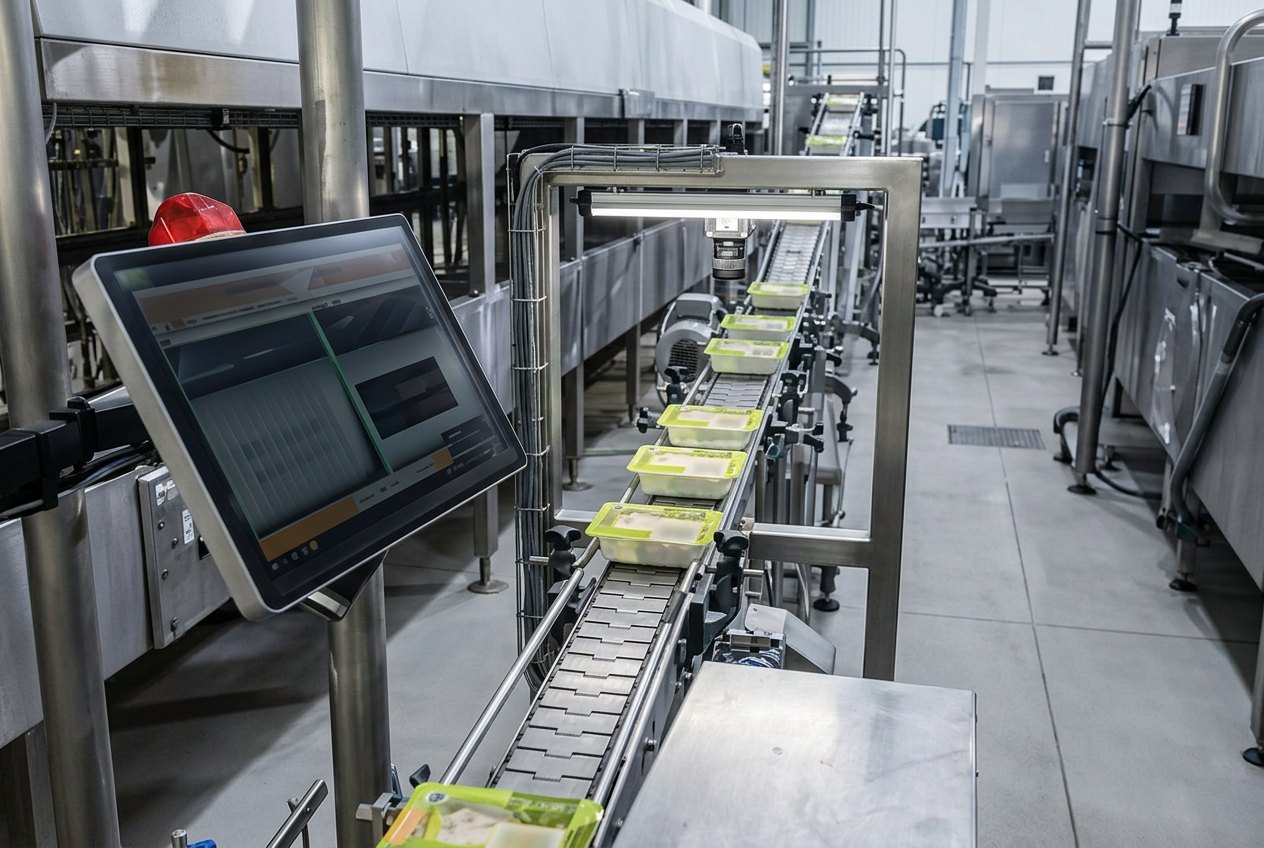
Representative application
Food packaging line with an inkjet date-code inspection monitor over trays on a conveyor
Inkjet date-code inspection on a food packaging line

Inspection target

Date and lot code verification on reflective pouches

Imaging challenge

Specular film, condensation, code legibility

Typical architecture

Diffuse or dome illumination to suppress specular return from the film

The problem

Codes printed onto metallized film are legible to an operator under one viewing angle and invisible to a camera under another. Condensation after a chilled step adds a variable, moving highlight over the print area.

Technical theme: Specular film, condensation, code legibility

Imaging approach

  • Diffuse or dome illumination to suppress specular return from the film
  • Polarization considered where highlights survive geometry changes
  • Global-shutter area scan, short exposure to freeze pouch motion
  • Hardware trigger from a photo-eye rather than free-run acquisition

Inspection logic

  • OCV against the expected string from the work order, not free-form OCR
  • Per-SKU recipe selection driven by the production order
  • Reason codes distinguishing no-print, partial print, and unreadable-image conditions

Validation plan

  • Labeled panel of good and defective pouches run at line speed
  • Escapes and false rejects reported separately, never as one accuracy figure
  • Retest after every lighting, fixture, or recipe change
Typical fit: multi-SKU packaging lines where the code must be verified against the work order rather than simply read.

Printing & converting

Repeating defect detection on a narrow printed web

Representative application
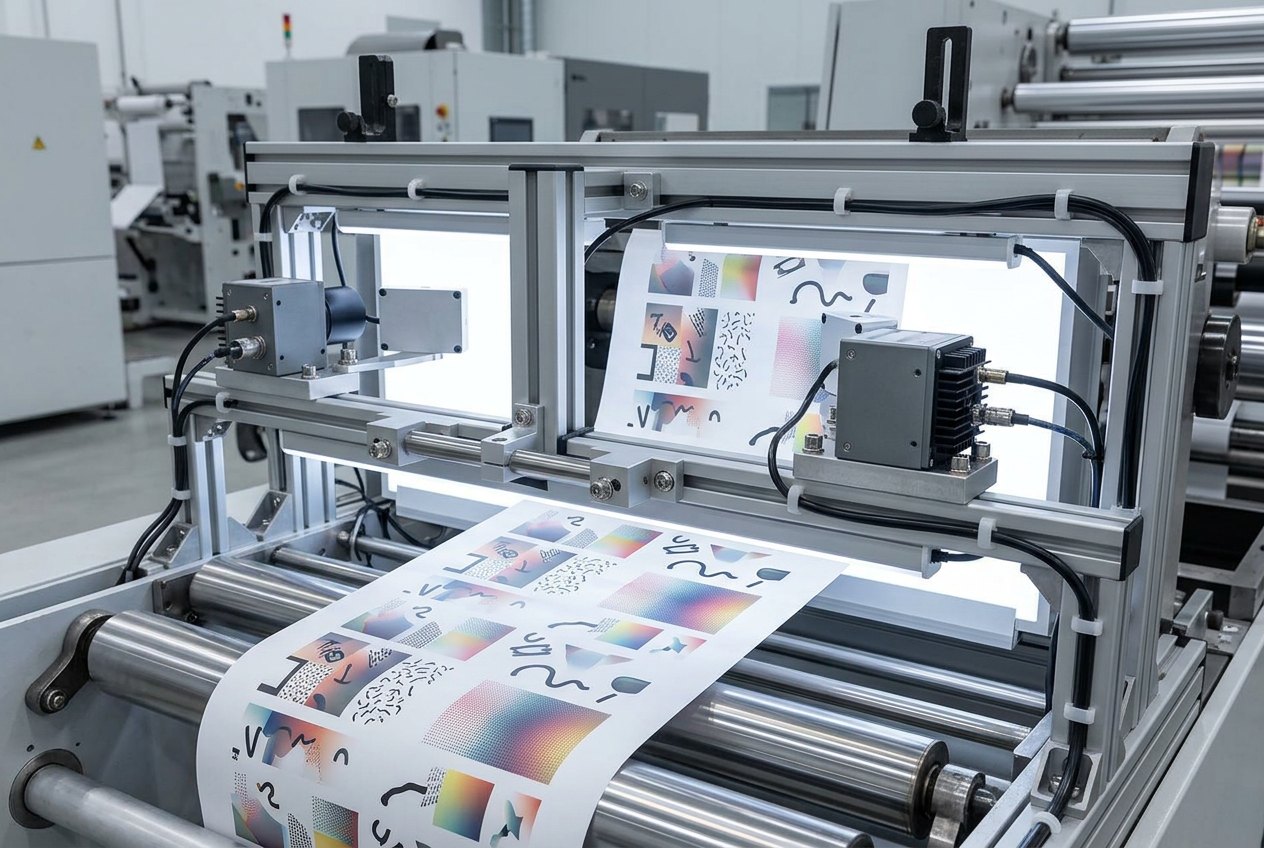
Sheet inspection rig with backlit printed sheets and two mounted inspection cameras
Printed-web inspection rig — backlit media and dual camera heads

Inspection target

Repeating defect detection on a narrow printed web

Imaging challenge

Line scan, encoder clocking, repeating plate defects

Typical architecture

Line-scan camera clocked from a web encoder so image scale is speed-independent

The problem

Streaks and voids appear intermittently and a repeating defect from a damaged plate can run for hundreds of feet before anyone downstream notices.

Technical theme: Line scan, encoder clocking, repeating plate defects

Imaging approach

  • Line-scan camera clocked from a web encoder so image scale is speed-independent
  • Uniform, high-intensity line illumination across the full web width
  • Lens selected for even resolution to the web edges, not just the center

Inspection logic

  • Defect classes separated into point defects, streaks, and periodic patterns
  • Repeat-period estimation to flag a probable plate or roller source
  • Roll map with defect coordinates for downstream finishing decisions

Validation plan

  • Seeded-defect trials at production speed across the full web width
  • Sensitivity documented per defect class, with the smallest reliably detected size stated
  • Operator review of borderline classifications during commissioning

Typical fit: continuous web and converting lines where a repeating defect can run for hundreds of feet before it is caught.

Consumer packaged goods

Label presence, placement and orientation on rigid containers

Representative application
Label position inspection monitor mounted on a packaging line showing measured label placement
Label-position offset inspection at the line

Inspection target

Label presence, placement and orientation on rigid containers

Imaging challenge

Placement tolerance, wrap distortion, changeover

Typical architecture

Multiple viewpoints or container rotation to cover the wrap

The problem

Labels can be present but skewed, wrinkled, lifted at the edge, or correct for the wrong SKU. Curvature compresses the printed area toward the edges of the field of view.

Technical theme: Placement tolerance, wrap distortion, changeover

Imaging approach

  • Multiple viewpoints or container rotation to cover the wrap
  • Illumination chosen to reveal edge lift and wrinkle shadowing
  • Fixturing that constrains presentation before software is asked to compensate

Inspection logic

  • Placement measured against a datum on the container, not against the image frame
  • SKU identity checked from label artwork and code, not by operator selection alone
  • Recipes versioned so a changeover is a selection, not a re-teach

Validation plan

  • Tolerance study across container variation and label supplier lots
  • Repeatability check with the same container presented repeatedly
  • Changeover rehearsed with production operators, timed but not published

Typical fit: rigid-container labeling with frequent changeovers and placement tolerances that must be measured, not eyeballed.

Next step

Discuss your inspection problem with an engineer.

Send samples, line speed and the defect you cannot let through. We respond with an imaging assessment, not a brochure.